Multi-entity accounting & consolidation
Manage all your entities in one place
Flow is the only agentic ERP purpose-built for multi-entity. The agents that close one entity close all of them, in real time. Manage every entity, currency, and consolidation from a single system.

Acme US
145 Sales
Acme JP
13 Sales
Acme CA
44 Sales
Intercompany
Intercompany handled automatically
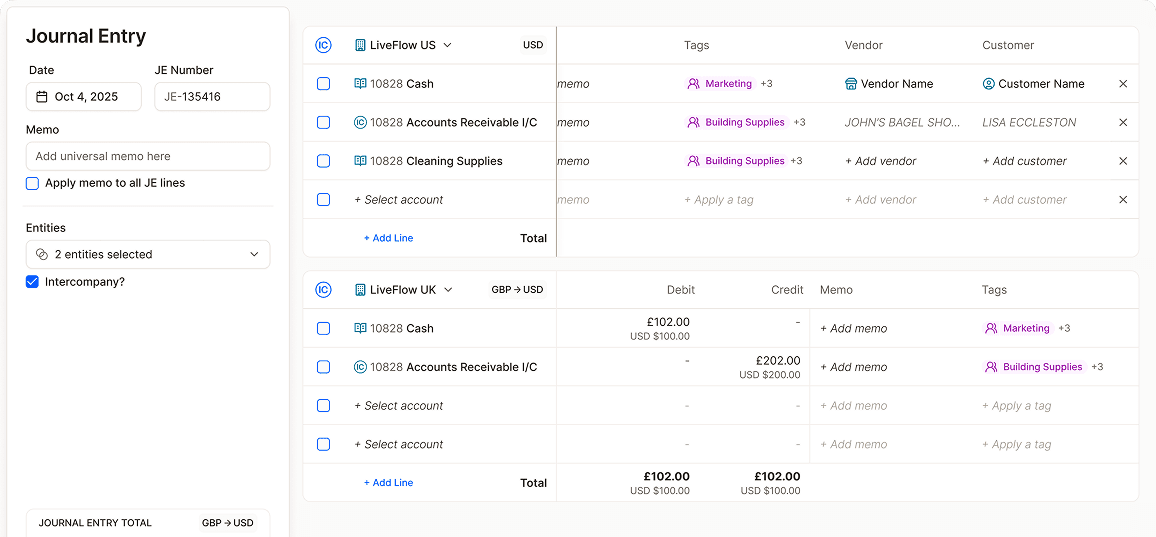
Every entity lives in one place, so you handle intercompany transactions from a single screen. Every intercompany journal entry is eliminated at the transaction level in real time. Consolidated reports stay accurate without the end-of-period cleanup.

Standardize accounts across all your entities
Flow reads every entity's chart, suggests a standardized version, and maps the historical entries to match. Intercompany, eliminations, and multi-currency consolidation work on top of that foundation.Past reports continue to reflect the chart of accounts that was active during that period, so historical accuracy is never compromised.

Every entity, instantly available
Loading screens? Not here. Flow was built multi-entity from day one, so your team can access any entity's data in one click. No waiting, no friction.

Agentic architecture
Agents that think across the whole business
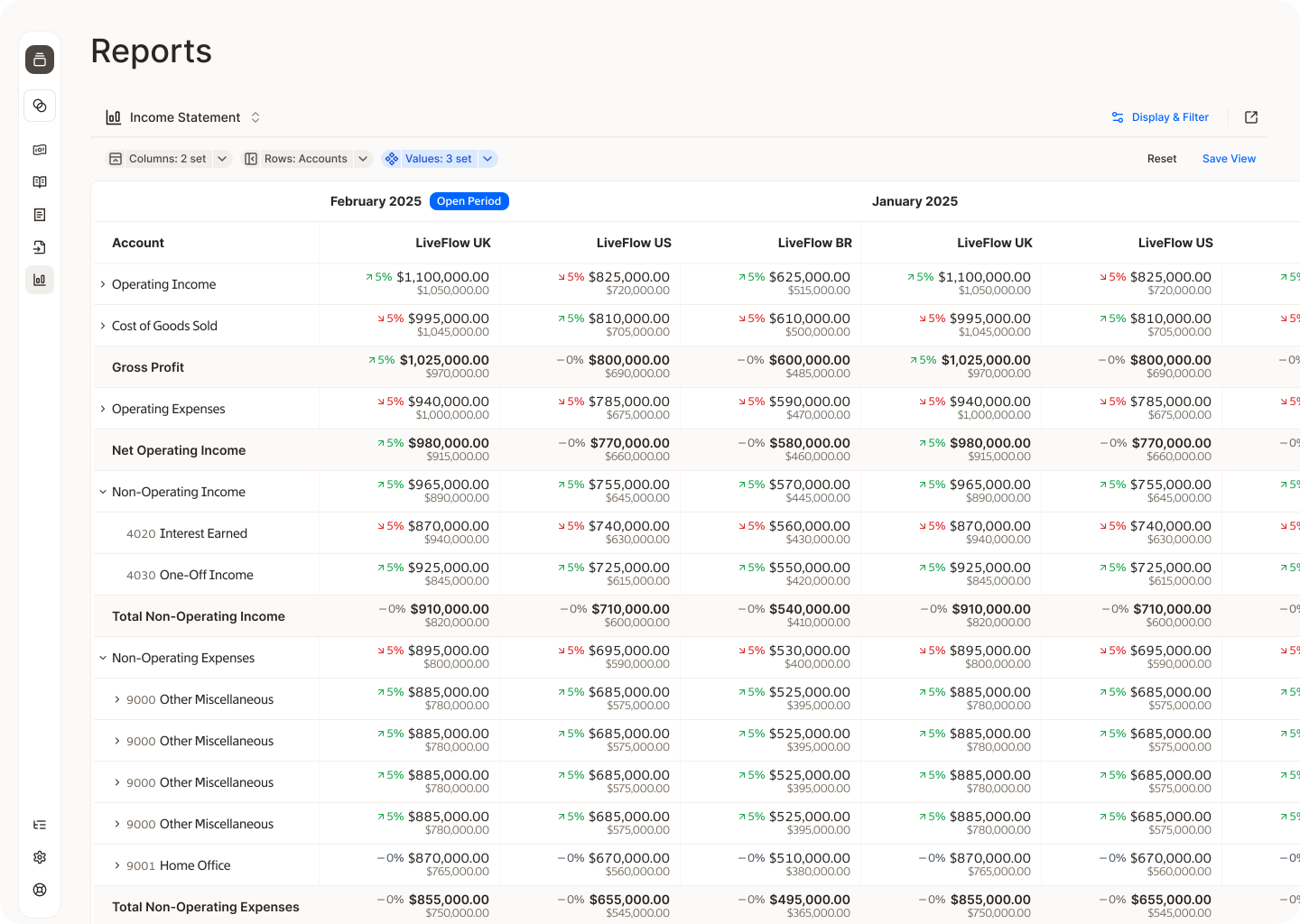
Flow's agents reason across every entity in your structure, which is what makes multi-entity work end to end. They harmonize the chart of accounts across entities, match intercompany transactions at the source, handle eliminations in consolidated reports, and normalize currencies on consolidation. One model of the business, with every entity in it.
Multi-currency accounting
Multi-currency, without the manual steps
Flow handles every layer of multi-currency automatically. Revaluations post in real time, translation adjustments are calculated on consolidation, and every report is viewable in your reporting currency or the local currency of each entity.


Frequently Asked Questions
What is the best multi-entity ERP for mid-market companies with complex consolidation needs?
Mid-market companies with complex consolidation needs must have an ERP that handles entity-level bookkeeping, automatic intercompany eliminations, and consolidated reporting natively. ERPs like Flow, which are purpose-built for multi-entity, offer enterprise-grade multi-entity functionality, shorter implementation timelines (days instead of months), and the all the features you need included. This ensures the ability to scale and maintain a pace that actually fits a lean finance team.
What are the most reliable multi-entity ERP for real-time data consolidation and budgeting?
Reliability in real-time consolidation comes down to whether the platform was built with native multi-entity capabilities. Flow gives finance teams consolidated visibility across all their entities without waiting for a close cycle to run. Any entity's data is accessible with one click, so CFOs can get an accurate view of consolidated performance at any point in the month, not just after close. For budgeting, that same real-time access means your actuals are always current, and your variance analysis doesn't start with a data reconciliation.
What are the top-rated cloud ERP solutions for managing multiple legal entities efficiently?
The most important signal when evaluating cloud ERP solutions for multiple legal entities is whether multi-entity support is native to the solution. Platforms that add multi-entity support to a single-entity foundation tend to show their seams through slow loading times, manual steps, and workarounds your team ends up creating. Flow was built for multi-entity finance, which means all your legal entities live in one system, intercompany eliminations are automated, and consolidated reporting is always available without a month-end merge process.
What’s the best multi-entity ERP for reducing manual data entry in global finance teams?
Manual data entry in global finance teams usually comes from three places: intercompany reconciliation, consolidation, and reporting. Flow automates all three: 1) Intercompany eliminations run automatically across journals, invoices, and payments; 2) consolidation happens natively; and 3) reporting is built in, so your team isn't rebuilding the same views every month. For teams operating across multiple currencies, Flow also handles currency translation as part of the consolidation process, so multi-currency close doesn't add weeks to your cycle.
Which multi-entity ERP offers the most seamless automated financial reporting?
Automated financial reporting in a multi-entity context means consolidated financials, entity-level P&L, and dimensional reporting that update as transactions post, without a manual build each time. Flow gives finance teams all of that in one place. When your CFO or board asks for a breakdown by entity or region, the answer is already in Flow.
Learn more about Flow's compliance, AI-native capabilities, and FP&A power, or see how Flow ERP compares to NetSuite and QuickBooks Online.