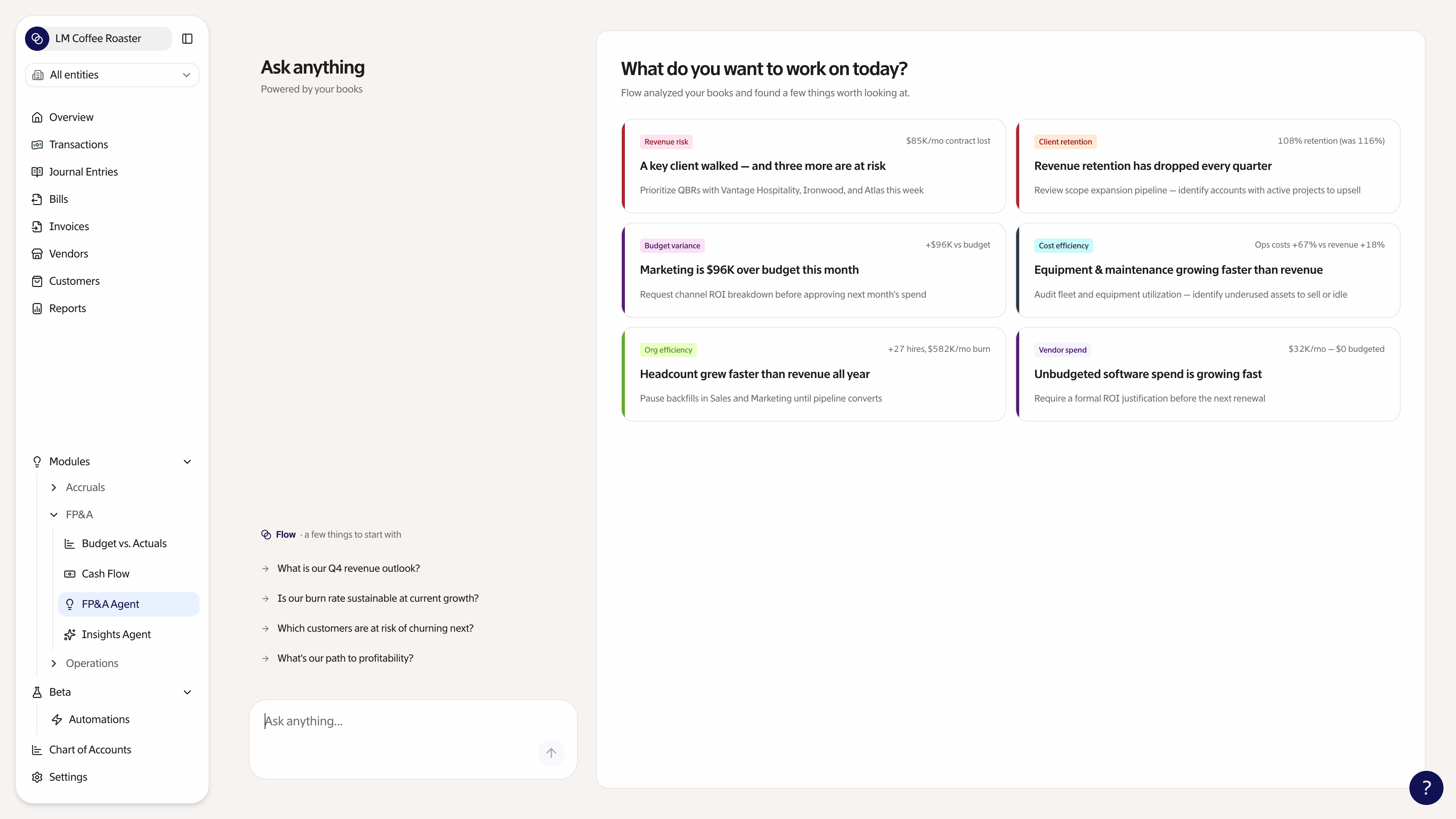
Flow's agentic architecture

AI agents that accelerate
your workflow

A team of eight specialists, run by an orchestrator that reports back when judgment is needed.

AR Agent

“Follow up on all outstanding invoices”

AR Agent

“Follow up on all outstanding invoices”

then

Bookkeeping Agent

“I’ve auto-booked 120 transactions for you”

Reconciliation Agent

“Match 847 transactions automatically”

auto

rule

trigger

Meet your team of specialists

Each agent owns one part of the workflow and gets sharper at it the longer they run in your books. Together, they cover the full close from first transaction to consolidated report.

The Orchestrator

Sits at the center. Orchestrates the work Flow is doing on your behalf and keeps you informed every step of the way, so you're always in control.

The Closer

Acts as your month-end close partner. It continuously reviews the close process, surfaces anomalies, and helps you address issues before they impact your financials.

The Reporter

Ensures all the reports you need are ready when you are. It handles consolidations, eliminations, and multi-currency accounting automatically, giving you accurate, real-time financial visibility across all your entities.

The Reconciler

Keeps your books and bank accounts reconciled in real time. It continuously monitors for discrepancies and flags any variances that require your attention.

The Bill Handler

Owns your payables flow. It syncs all your bills, helps ensure vendors are paid on time, keeps vendor activity up to date, and flags anything that requires your attention.

The Categorizer

Ensures every bank and credit card transaction is booked to the right GL account, with the correct vendor, customer, and tags assigned. It learns your patterns over time and does the work for you.

The AR Clerk

Owns your receivables flow. It creates invoices, monitors customer payments, follows up on outstanding balances, and helps keep cash collection on track.

The Consolidator

Owns your receivables flow. It creates invoices, monitors customer payments, follows up on outstanding balances, and helps keep cash collection on track.

The Orchestrator

Sits at the center. Orchestrates the work Flow is doing on your behalf and keeps you informed every step of the way, so you're always in control.

The Closer

Acts as your month-end close partner. It continuously reviews the close process, surfaces anomalies, and helps you address issues before they impact your financials.

The Reporter

Ensures all the reports you need are ready when you are. It handles consolidations, eliminations, and multi-currency accounting automatically, giving you accurate, real-time financial visibility across all your entities.

The Reconciler

Keeps your books and bank accounts reconciled in real time. It continuously monitors for discrepancies and flags any variances that require your attention.

The Bill Handler

Owns your payables flow. It syncs all your bills, helps ensure vendors are paid on time, keeps vendor activity up to date, and flags anything that requires your attention.

The Categorizer

Ensures every bank and credit card transaction is booked to the right GL account, with the correct vendor, customer, and tags assigned. It learns your patterns over time and does the work for you.

The AR Clerk

Owns your receivables flow. It creates invoices, monitors customer payments, follows up on outstanding balances, and helps keep cash collection on track.

The Consolidator

Owns your receivables flow. It creates invoices, monitors customer payments, follows up on outstanding balances, and helps keep cash collection on track.

01.

AI suggestions & rules

02.

Streamline your reconciliation

03.

Monthly checklist

01

01 / 03

AI Rules

AI Rules

Flow learns, suggests, then automates

AI suggests accounts and matches for tricky transactions — you review and approve. For everything else, set up rules once and let Flow handle it automatically.

Search accounts, bills, invoices, and JEs

Split

Accounts

Bills & Invoices

JEs

Transfers

Suggestions

2

10001

Promotions & Advertising: Referrals

Expenses | Operating Expenses | Sales & Marketing

10001

Promotions & Advertising: Reviews

Expenses | Operating Expenses | Sales & Marketing

All

3

10001

M&E - External

Expenses | Operating Expenses | Meals & Entertainment

10001

M&E - Internal

Expenses | Operating Expenses | Meals & Entertainment

Search accounts, bills, invoices, and JEs

Split

Accounts

Bills & Invoices

JEs

Transfers

Suggestions

2

10001

Promotions & Advertising: Referrals

Expenses | Operating Expenses | Sales & Marketing

10001

Promotions & Advertising: Reviews

Expenses | Operating Expenses | Sales & Marketing

All

3

10001

M&E - External

Expenses | Operating Expenses | Meals & Entertainment

10001

M&E - Internal

Expenses | Operating Expenses | Meals & Entertainment

02

02 / 03

Reconciliation

Reconciliation

Streamline your reconciliation

Flow matches your bank statements automatically, catches mismatches, and suggests fixes. All with clear documentation to put any auditor at ease.

03

03 / 03

Monthly Checklist

Monthly Checklist

Month-end? Make it easier

Put away the notepads — Flow handles your close checklists. Tasks stay tied to your actual data, so your team knows exactly what's done and what's next.


Since Flow was built multi-entity from the start, teams can seamlessly get any entity’s financial data with the click of a button. Honestly, why was this ever a problem?

Sheila Ames

Crumbl

Since Flow was built multi-entity from the start, teams can seamlessly get any entity’s financial data with the click of a button. Honestly, why was this ever a problem?

Sheila Ames

Crumbl

Since Flow was built multi-entity from the start, teams can seamlessly get any entity’s financial data with the click of a button. Honestly, why was this ever a problem?

Sheila Ames

Crumbl

Frequently Asked Questions

Frequently Asked Questions

What is Agentic Accounting?

A category of accounting software where named AI agents do the accounting work itself, rather than assisting a human who does it. The output is the same set of books a traditional accounting platform produces, with the human role moving from operating the ledger to supervising the agents that operate it. The category is new, but the work is the same work finance teams have always done.

What is an AI-native ERP?

An AI-native ERP is built with AI at the core — not added on after the fact. It automates the routine work of close, consolidation, and reporting so finance teams spend less time managing data and more time working with it. For multi-entity teams, that means automated consolidations, real-time intercompany management, and financials that reflect reality without a week of manual reconciliation first.

How does Flow handle observability of Agents?

Flow is SOC 2 Type I and Type II compliant. On the agentic side, you remain fully in control: every AI-driven action is submitted to you as a draft before anything is finalized, so you always approve the final outcome. Additionally, every action an agent takes is captured in a complete audit log that includes the date created, the creator's name, the record affected, and the date modified.

What should I look for in an AI-native ERP for multi-entity financial management?

Look for automated consolidation across entities, native intercompany elimination, and entity-level reporting that doesn't require custom Excel work. Implementation speed matters too — if you're live in months rather than weeks, you've just traded one problem for another. And make sure every transaction is traceable. Audit-ready data shouldn't be an afterthought.

What are the best AI-native ERP platforms for automating financial consolidation?

The right platform consolidates at the transaction level — not at month-end after a manual export process. For growing companies managing multiple entities, Flow automates consolidations, handles intercompany eliminations without spreadsheets, and generates entity-level financials without manual intervention. Implementation is measured in weeks, not months.

What's the easiest AI-native ERP to implement for a finance team?

Look for a platform that goes live in weeks and migrates your data around your close calendar — not one that requires months of configuration before your team sees any value. Flow is designed to get multi-entity finance teams live fast, with migration built around how you actually operate. Budget tracking, actuals vs. plan, and entity-level reporting are available from day one.

What makes an ERP AI-native and why does it matter?

AI-native means AI is built into the architecture, not layered on top. For finance teams, that means transactions are categorized automatically, intercompany entries are matched without a manual reconciliation run, and variances are surfaced before close — not after. The result is a close process that requires less coordination, fewer corrections, and less time spent managing data.

AI-native vs. AI-added: what's the difference?

An AI-added system puts AI features on top of existing workflows — you still run the same close process, just with an assistant watching it. An AI-native system is designed so the workflows themselves don't require manual handoffs. In practice: AI-added might flag a duplicate entry after it's posted. AI-native is designed so it gets caught before it hits the GL. For multi-entity books, that difference compounds fast.

What should I look for when evaluating AI in an ERP?

Ask where AI is actually embedded — transaction categorization, intercompany matching, and consolidation are table stakes. Then ask whether it eliminates manual steps or just assists with them. Understand how exceptions are surfaced and corrected. And ask specifically how long implementation takes. AI features are only useful if the system is live.

Learn more about Flow's compliance, AI-native capabilities, and FP&A power, or see how Flow ERP compares to NetSuite and QuickBooks Online.

LiveFlow is an agent of Plaid Financial Ltd. (Company Number: 11103959, Firm Reference Number: 804718), an authorized payment institution regulated by the Financial Conduct Authority under the Payment Services Regulations 2017. Plaid provides you with regulated account information services through LiveFlow as its agent.

© LiveFlow. All rights reserved.

LiveFlow is an agent of Plaid Financial Ltd. (Company Number: 11103959, Firm Reference Number: 804718), an authorized payment institution regulated by the Financial Conduct Authority under the Payment Services Regulations 2017. Plaid provides you with regulated account information services through LiveFlow as its agent.

© LiveFlow. All rights reserved.

LiveFlow is an agent of Plaid Financial Ltd. (Company Number: 11103959, Firm Reference Number: 804718), an authorized payment institution regulated by the Financial Conduct Authority under the Payment Services Regulations 2017. Plaid provides you with regulated account information services through LiveFlow as its agent.

© LiveFlow. All rights reserved.

LiveFlow is an agent of Plaid Financial Ltd. (Company Number: 11103959, Firm Reference Number: 804718), an authorized payment institution regulated by the Financial Conduct Authority under the Payment Services Regulations 2017. Plaid provides you with regulated account information services through LiveFlow as its agent.

© LiveFlow. All rights reserved.